
EHLS: All-Time Highs
Amidst Record Metal Volatility

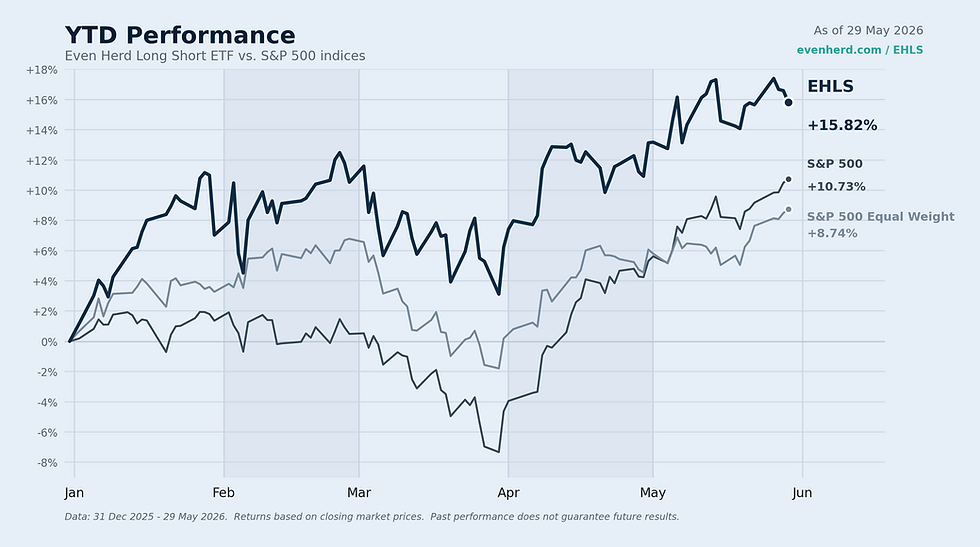
We are proud to report one of the fund’s strongest monthly performances since inception. In January 2026, the fund gained +7.07% (MKT), significantly outperforming the S&P 500, which rose approximately +1.45%. The fund captured nearly five times the index’s upside for the month. During January, the fund briefly exceeded +11% (MKT) year-to-date before pulling back late in the month amid sharp reversals across several key themes. Despite the volatility, the fund reached an all-time high during the period.
|
IN THIS UPDATE
• EHLS delivered one of its strongest months since inception in January 2026, significantly outperforming broad equity markets through disciplined relative momentum rotation. |
• Precious metals miners drove the majority of gains as gold and silver surged early in the month before experiencing one of the most extreme late-month reversals on record. |
• Active portfolio management included tactical trims and tax-efficient redemptions to control single-name risk while maintaining thematic exposure. |
• The proprietary system continues to signal a dominant leadership gap in the miners cluster, supporting sustained overweights in Materials and Utilities. |
• Energy exposure is building as relative strength improves, while Consumer Staples, Real Estate, and select software and insurance industries remain structurally weak. |
LOOKING BACK
For most of January, the fund benefited from strong upside in the precious metals space, particularly among miners. This trend persisted until the final trading day of the month, when silver prices declined sharply. Reports cited intraday drops of up to 35%, marking one of the most extreme single-day moves since 2008 and reflecting aggressive profit-taking after parabolic gains.
Despite this volatility, precious metals closed the month meaningfully higher overall, with silver still posting strong monthly gains of roughly 10%. During the advance, we implemented select trims and tax-efficient redemption strategies in positions that experienced outsized appreciation, ensuring no single holding exceeded 2% of fund exposure.
Given the lack of offsetting short opportunities to fully hedge the theme, we remained mindful of exposure levels. Our clustering framework and broad diversification across individual names helped mitigate concentration risk during the late-month reversal.
This positioning was reflected in meaningful allocations to names such as Kinross Gold (KGC), Hudbay Minerals (HBM), and Agnico Eagle (AEM), along with adjacent exposure including Cameco (CCJ) in uranium and other precious-metals-linked holdings such as PPTA and SBSW, all of which contributed positively prior to month-end pressure.
LOOKING FORWARD
Within the proprietary system, the miners cluster continues to exhibit the largest leadership gap, and we expect it to remain an overweight in the coming months barring a material deterioration in rankings. This supports a continued overweight to the Materials sector, alongside sustained exposure to Utilities, which also remain in leadership. Current holdings reflecting this include ETR, ENLT, and ORA.
As previously discussed, Energy continues to show improving relative strength, and we anticipate maintaining or modestly increasing exposure as the trend develops.
On the underweight side, Consumer Staples and Real Estate remain among the weakest areas in the system, with little indication of near-term improvement. Communication Services and Consumer Discretionaryweakened during January, and we expect to remain underweight these sectors in the near term. At the industry level, software and insurance brokerage continue to rank among the weakest on a relative momentum basis.
STRUCTURAL SHIFTS AND AI ADAPTATION
Markets are increasingly recognizing the structural challenges facing legacy software businesses in an AI-driven world. The magnitude of declines across several once-dominant franchises has been notable. Fund shorts such as Adobe (ADBE), HubSpot (HUBS), and Atlassian (TEAM) are down well over 50% over the past 12 to 18 months. Fiserv (FISV) has declined more than 75% from its 2025 highs—an outcome that would have seemed improbable just a year ago.
This disruption extends beyond software. Insurance brokerage businesses continue to experience severe declines, including CorVel (CRVL), now down more than 55% from its all-time high. In our view, this is not a period for financial engineering or buybacks, but one that demands investment and adaptation. The models are now capable enough to accomplish the majority of tasks done on a computer, unlike recent doubts in years past, but knowing they'll only imiprove from here is captivating and will be brutal to any company ignoring it. This is not a slow evolution like computers or even the internet for that matter, which took time and allowed for companies to generally adjust.
Today, companies are forced to shift timelines from years to months or weeks, like mentioned by Shopify's CEO. For years, AI was astoundingly dismissed by some as a passing trend. That narrative has been decisively invalidated. The market is now awakening to the reality that AI adoption is no longer optional, and the pace of change is accelerating faster than initially anticipated.
In the nearer term, certain businesses face greater risk—particularly those serving highly technical or engineering-driven clients who can now build superior, customized solutions at lower cost. Platforms such as Replit, among many others we have evaluated, already enable users to develop increasingly sophisticated systems with little to no programming knowledge. The depth, quality, and economic value of these tools continues to accelerate, empowering smaller and more adaptive players.
Deep entrenchment alone is becoming an unreliable growth strategy. Consumers and enterprises increasingly expect technology that is seamless, intuitive, and simply “works,” requirements that necessitate AI at the core. Younger generations will grow up with these capabilities as a baseline expectation rather than a novelty.
While we incorporate many of these considerations into portfolio management, execution remains guided by the system itself. For example, Spotify (SPOT)—a company we previously held and discussed at our reluctant exit—has continued to decline and is now down more than 40% from its 2025 highs. However, we view its core business as relatively insulated from near-term AI disruption and will continue to monitor it for potential re-entry when system signals permit.
VOLATILITY WITHIN LEADERSHIP
In the industrial and precious metals complex, it remains unclear whether recent moves represent the start of a deeper correction or simply a period of extreme volatility reminiscent of price behavior last witnessed in the 1970s. Regardless, the fund intends to maintain exposure as long as rankings remain supportive. Given the magnitude of the current leadership gap, an imminent breakdown appears unlikely.
We do not intend to add meaningfully to exposure at this time, but we plan to maintain existing positions or rotate among peers as rankings evolve, utilizing tax-efficient redemptions where appropriate. While short opportunities may eventually emerge, miners remain in powerful long-term uptrends, with many positions still positive for January despite severe drawdowns.
At present, this appears to be volatility within an ongoing uptrend, and the fund remains positioned accordingly.


Comments